20 May 2018

Chemical Heritage

This aluminum necklace was on display at the Chemical Heritage Foundation (CHF) in 2010. It was part of the CHF's Chemistry and Fashion: Making Modernity exhibit. A description of the necklace is still available via an unfortunately image-free post about Atomic Age women's jewelry

I like the necklace, a lot! Aluminum is very light; I do wonder whether the same necklace could be made of platinum or possibly iridium. If so, how it would it compare--in appearance (e.g. lustre) and weight-- to the aluminum version?


Ladies necklace made of grey metal nested wedges
Aluminum necklace circa 1950

I wrote this post in October 2010. Times changed at the Chemical Heritage Museum since then, resulting in many broken links. This is an expanded version of that post, with replacement by valid alternative links for inline URLs. I apologize if I missed any. 

URL persistence hasn't been taken as seriously as the IETF and Internet Society had hoped; URL status, according to a Google Groups thread, as of 2013:

URLs are simply not persistent...from a recent study, about 15% of URLs from a large sample reach a lifetime of 1000 days. It's abysmal. And other studies back it up.

No Moore Chemical Heritage

Sadly, Chemical Heritage was absorbed by the Science History Institute in 2018, including the CHF's 5-story building. Most CHF collections can still be viewed at the museum's original location, at 315 Chestnut Street in Philadelphia, Pennsylvania. I was born in Philadelphia, and attended graduate school there, so I feel an affinity. 

The former CHF building is near Centennial Hall, the Liberty Bell, and adjacent to a nice residential neighborhood called Society Hill. Penn's Landing is a few blocks to the east. That's where William Penn first arrived on the shores of America. 

Gordon E. Moore helped found the Chemical Heritage Foundation, and his generous donations provided much of the initial and sustaining funds.

Moore's Law


magazine cover
Periodic Tabloid: 
Musings on the Molecular

Interested in the legacy of Gordon Moore? A reproduction of his 1966 article, in which he introduced his famous law, is included in Understanding Moore's Law: Four Decades of Innovation. The book also recounts many observations by Moore, his peers, competitors, and others. It was written in order to commemorate the 40th anniversary of Moore's Law. 

Although "Understanding Moore's Law" was published by the now defunct CHF Press, the Science History Institute kindly keeps an electronic version of the full text available as a PDF for online readers.

Heritage of Chemistry: Moore notable, noble chemists

I promise that this heading will be my final pun for today. It is a double pun, the best kind!

When I first wrote this, chemist and materials scientist Andre Geim had recently won the Nobel Prize.  In merely 10 years, he went from the dubious distinction of receiving an IgNoble prize for levitating frogs with magnets to winning the Nobel Prize for producing a one atom-thick material consisting of carbon atoms, arranged in a hexagonal lattice.  Geim named it graphene, and mapped its properties: incredibly thin but still incredibly strong, good heat and electrical conductivity, almost entirely transparent yet very dense.

03 August 2016

How To Rob An Online Bank And Get Away With It

Ambitious!

"The subject of our dissection is an online bank robbery

Not the all-too-common attack against an online banking user, his computer and his identity, but an attack against the bank itself - or more precisely, against the bank's online banking application.

An online banking attack has four distinct phases:
  1. Vulnerability Finding Phase
  2. Vulnerability Exploitation Phase
  3. Buying Time Phase
  4. Extraction Phase..."

via ACROS Security Blog: Anatomy Of An Online Bank Robbery 

17 March 2016

AOL Running Man Lives!

The running man created by AOL (American Online) was, and maybe still is, the most iconic representation of Internet dial-up connections for many users from the mid-1990s to 2010.

Apparently, he was still making appearances at tech events as recently as 2009, as seen here in Washington D.C.

yellow AOL running man
Running Man at TECH Cocktail DC 6


Location: Left Bank in Adams Morgan, Washington D.C. on August 27, 2009. Photo by Shawn Duffy, via Flickr.

I wish I knew the context for his appearance! I wish I had had a chance to see Running Man too.

21 January 2015

Cartography of Second Life

Surprise! Cartography enthusiast and mapping patron David Rumsey was there too: Viewing Second Life.

Ellie with radio in SL
Me


I am Ellie Heartsdale. I owned a small corner plot of land on an island sim in the west. I built a little house there, for me and the piggies. I went to the Second Life synagogue, in Nessus, on Friday nights.

Second Life animals
Piggies


My father was still alive then. I was working for the State of Arizona, Department of Health Services, Office for Children with Special Health Care Needs, as chief research statistician. That was my title, "Research Statistician, chief".

I was happy, but as usual, didn't realize it at the time.

Maps


05 August 2014

Physikalische Typografie

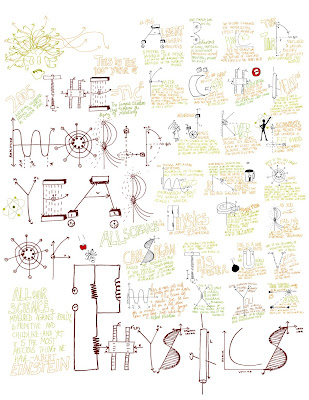
This is a situation where the German language -- not French, nor Italian and certainly not English, really captures the feeling and nuance of a work of art most eloquently. Physikalische Typografie* means "Typography of Physics."

I like that much better than my prosaic versions:
  • An Alphabet of Physics Diagrams?
  • Creatively Capturing Fonts with Physics
  • 26 Physical Letters
This post is about physics-student-turned artist MunnaOnTheRun, and the story of his rather abrupt transition to artiste and graphic designer. The catalyst for his transformation was quite literally the Unified Field Theory of Physics. MunnaOnTheRun, and Wikipedia, refer to it as The Theory of Everything. It is (a yet to be proven theory) linking all known physical phenomena. Albert Einstein was intent on tracking it down in the last decade of his life.

Background


MunnaOnTheRun was an enthusiastic student. Unfortunately he was also a miserable failure in physical science coursework, by his own admission.

World Year of Physics || {Physics + Typography} by Munna

Now, fast forward in time. 2005 was designated World Year of Physics in commemoration of Einstein's Theory of Relativity centennial. MunnaOnTheRun wanted to create a typeface from physics diagrams for the event.

This is the story of his success, in the artist's own words:
After months of research... I finally got hold of 26 diagrams that looked liked the letters of the alphabet. This poster literally transported me into a parallel universe. I sent this around to graphic designers .... With no formal training in art, and nothing to show for except badly drawn doodles, I started believing that I could make art.

Physics changed everything for me.
* The website ILoveGraffiti coined that pithy phrase, Physikalische Typografie.

31 July 2014

Cassandra Is Sooooooo Correct

Nihon Cassandra is more of a stock market investor than macroeconomics type. In other words, she isn't really into bonds. In her own charming words,
So long as my distribution is skewed-right, and the tail not overly kurtotic, I am sanguine.
Recently, Cassandra excoriated herself for failing to predict our current global macroeconomic malaise, specifically, the odd lack of self-preserving behavior by those who have the most to lose. I think she is being unnecessarily harsh, as she understands far better than many others do, even now.

It was a close call. From September 2007 through 2010, the masters of financialization escaped ruin by the skin of their teeth. Saving the system, at public risk and expense, was useful to asset holders, e.g. the AIG crowd, Goldman Sachs and friends, Stevie Cohen, Walmart family scions, Icahn, Einhorn, Pritzkers, Koch brothers, Larry Ellison, Larry and Sergei Google, Mark Z, Jeff Bezos, Bill and Melinda, other much less publicly known owners of nation-sized yet privately owned wealth.

03 June 2014

If he were a spy

I looked for answers on Quora, a question-and-answer website.

Is Jacob Appelbaum a U.S. government employee?


He gets a huge salary from the Tor Project but mostly jets around the world, more lavishly than celebrities and movie stars. His home is chic, minimalist but opulent according to Rolling Stone. He posed with semi-automatic firearms in Iraq in 2008. He parties ALL the time, based on his flickr photographs. [These photos are no longer visible other than to logged-in flickr users with adult content viewing enabled. I embedded a few as part of my question on the Quora website and question comments.]

The question doesn't really seem to follow from the details, Ellie?

Granted, but maybe this will help to explain. Tor is a former US government project. Jacob works, or worked for Tor. I was trying to avoid asking directly whether Jacob were a spy. That would be indiscreet, so I said "US government employee" instead.

Jacob has more fans and cart blanche globally than, well, I don't even know who to compare with him. He is like the Larry Ellison or Eric Schmidt of crypto fandom, but without any visible means of support. I don't see his name on the cryptography research server IACR as an author, nor any ACM nor IEEE scholarly journals, not even the Financial Cryptography conference.

ioerror is, well, to make an analogy, like the subversive version of Google's Jared Cohen. ioerror is the cool kids' hero, so to speak.

23 May 2014

Message of the market

Joe Saluzzi tried to get the word out. He really did make a good faith effort. This was one of his numerous appearances on Bloomberg, Fox Business News, CBS etc. The mainstream news media did not ignore him. He was interviewed for about 10 minutes in each station's Manhattan studio. Each appearance was broadcast live. Receiving that much air time is unusual.

13 May 2014

The Cleveland Fed Drawing Board goes silent

I find Cleveland to be the most friendly of the 12 Federal Reserve districts. They do a lot of community outreach work, and have a good research department.
    Evidence of friendly Cleveland Fed!

The Federal Reserve Bank of Cleveland is the headquarters of the U.S. Federal Reserve System's Fourth District. The district is composed of Ohio, western Pennsylvania, eastern Kentucky, and the northern panhandle of West Virginia.

Fed Reserve building in Cleveland, Ohio
Main office in downtown Cleveland since 1923

The Cleveland Fed building was designed by architects Walker & Weeks. The building is considered an historically significant piece of architecture. I like how it looks too. Apparently, few know much about the art and architecture of the building, not even in Cleveland!

24 November 2013

Bitcoin in the limelight: Questions for buyers and investors

Bitcoin exchange vulnerability

The most high-profile vulnerable Bitcoin exchange was Mt. Gox. In April 2013, Mt. Gox was overwhelmed by a Distributed Denial of Service (DDoS) attack. The point, Mt. Gox speculated, was to destabilize Bitcoin transactions and fuel panic selling. After driving prices down, the attackers ceased the DDoS, and rushed in to buy Bitcoin at a lower price.

Life isn't fair but Bitcoin must be

Life might not be fair, but securities exchanges and currency markets require fairness. Without it, they will die. Trust is essential. Apparently, Mt. Gox was robust enough to withstand this DDoS incident. In their pursuit of unearned profits, the attackers took a selfishly short-term view. DDoS attacks and market manipulation can destabilize Bitcoin exchanges. If that happens often enough, it will undermine credibility in Bitcoin.

Mt. Gox wasn't uniquely vulnerable. In the past few months, there were other DDoS-related Bitcoin extortion incidents: BTC-China was brought down in September 2013, and BIPS, a European payment provider, experienced a DDoS attack two days ago, on 26 November 2013.