17 June 2011

Finding the L0L0 cat

In the days of Google's youth

This is one of my favorite April Fool's Day special features from Google. The video is brief, so do listen, please? 


Things were different then, even though the year was already 2012. The Google Tokyo employee in the video is a native Japanese language speaker. Notice how he has fun with us, pronouncing all his "L"s as "R"s in English?! There's the subject matter as well, evoking Nintendo, I believe? That living room is so elegant and beautiful. 

Another subtle detail is the date. It is 31 March. Why? Well, because the date was already 1 April in Japan! 

I enjoyed the dial-up modem sounds.

The Google NES 8-bit is a replacement for what I had in its place when I originally wrote this. At the time, I had segued to something cartographic using a GIF from Funny Blog. Unsurprisingly, Funny Blog and the source of the GIF are both long gone. You'll have to use your imagination. The GIF was a special feline hybrid: The Cat Erpillar!

Funny Blog has a funny cat for you!
Source: Silver Jewelry Life

Where is the L0L0 cat?

The idea for this came to me from the lolcat internet meme, although this is more cartographic, than feline. I'll give one clue to solving the mystery of the L0L0 cat's location, and why it is special. The clue is:

"What is the name of the official Google map product blog on Blogger?"

Not the URL, but the name of the blog. I must intercede with another update. The official Google map product blog no longer exists under its prior name. (The format is worse too. Like every other website, each entry is arranged as a grid of square blocks, making it difficult to ever find anything.) In the past, it was called the Google Latitude Longitude Blog.

Have a look at the map, and observe the caption at the bottom center. The caption is truly L0L0 rather than LOL or LOLO

The map may be enlarged here by clicking on it. It isn't necessary to open it on another page if you don't want to, although you can by clicking the underlined caption below. I didn't use Google Earth, only Google Maps, so no additional software is required to view. (Google Earth formerly required a download of software in order to support 3D rendering.)


The triangular red map-marker--with an exclamation point--shows the physical location of the L0L0 cat but doesn't solve the puzzle.

I hope I haven't given the answer away.

24 May 2011

Ultra short epistemology post

So many clever people, such good writing, so little time!

I read something that I liked today. Let me share the joy. It seems fitting, particularly in these uncertain times, with a possible rapture scheduled for the weekend, amongst other things:
Probabilities are for understanding... Truth is a rhetorical device.
Tempered by this wry observation,
On the other hand, "justified at an 83.5% probability" leaves something to be desired for whipping the tribesfolk into a frenzied mob.

For more political economy-flavored thought delivered with the sincerity of an electrical engineer, see Aretae and his list of BlogFriends.

Some of my own favorites are featured:
  • The Volokh Conspiracy, which sounds sinister but isn't. They are actually a very loosely affiliated and mostly cordial cabal of blogging law professors.
  • The Money Illusion, a very sane and friendly site where the author and readers discuss serious policy matters in an agreeable, self-deprecating way. Two typically understated examples are Other activities bumped and Still Not Blogging.
  • xkcd: A math, physics and etymology web comic. It is also supposed to be about sarcasm and love, but there is not so much of that lately. I even wrote my own tribute to Randall Munroe, the author and creator of xckd in my earlier post, With love and geo-hashing.
  • Greg Mankiw's Blog: I think he won a Nobel Prize. He's an often reviled pillar of economic orthodoxy, whatever that actually means. Maybe "University of Chicago-school monetarist" or "economic heterodoxy" would be more accurate. He has an arrogant style sometimes, but is very bright. Bonus: Mankiw gives links to sites with nice free things. Like economics or statistics textbooks. Or gratis access to the Brookings Institute economics journal.
  • Overcoming Bias
  • Foseti on banking and regulatory capture
  • The Unenumerated: I really liked this post, Signals, Gifts and Politics.

31 January 2011

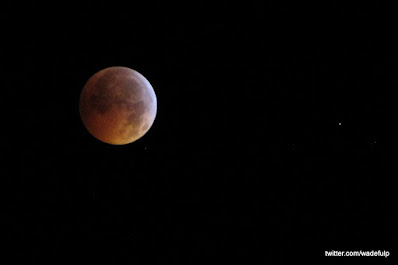
Lunar eclipse

Wade Fulp was one of my favorite photographers on Google- oops, I meant Google+ (minor lol). That's where Wade posted these pictures in January 2011. I'm unsure which lunar eclipse they are associated with. I tried to reproduce them here in chronological order. 

No, I don't know why some are red rather than silver-grey as one would expect of the moon. Also, I reproduced the images I liked the most in the larger sizes. 

EDIT 2025: It was possible to click through and view all of Wade's images in his Google Photos archive https://get.google.com/albumarchive/pwa/wadefulpng/LunarEclipse but Google retired Google Photos archives in 2023.

  
First

Second

Third


Fourth


Fifth


23 November 2010

Guide Me Home

A Near-Future Science Fiction Short Story

My journey began near the site of Google's offices in Beijing, shuttered and dark after permanent closure some years earlier by the government of the People's Republic of China. My destination was Camelback Road in Phoenix, in the U.S.A. My home. I could return. I had completed the assignment.

Pacific crossing


Time was not of the essence, thankfully. My transport choices in China were limited, to say the least. I didn't even have a bicycle! I would be traveling on foot for much of the journey. Fortunately, some ferry boats were still in operation. A kayak was waiting for me. Promises were kept. By ferry, occasional kayaking and motorboat relays, I returned to  U.S. territory at long last, to Guam. Hawaii was next. I arrived without incident, intending to rest for a brief time.


         View larger map

Hawaii was beautiful. Photos on The Map did not lie. But I couldn't linger. I returned to my Map. It would be impossible to cross the treacherous waters from Hawaii to the U.S. mainland without it. I traveled by ferry boat and assorted small craft. This was the most difficult part of the route home.

Finally, after more than 100 days in transit, I reached the coastline of North America. I entered via the more negotiable waterways near  Vancouver, although I would've preferred Seattle-Tacoma. The directions said that several short intervals of kayaking would be necessary. I was prepared. I had kept my kayak, but was glad to see the last of it!

Paseo del Norte


I was very worried about the notoriously strict Canadian border patrol.

Fortunately, my contact at Google's Redmond headquarters was informed of the situation. He met me at the border, plying the guards with two crates of brand-new, shrink-wrapped Microsoft PCs with optical processors inside. They are, effectively, quantum computers, yet have the footprint of a Windows 7 wireless phone. Such wonderful contraband, complete with factory installed Chrome Operating System!

mobile phone steampunk style
Microsoft Optical PC: Small footprint prototype
 via the future and my imagination
You seem surprised. How so? Oh, my apologies!  I neglected to mention the massive consolidation that American industry and technology underwent during the economic and societal Aftermath.  That's how we refer to it now.

Euphemisms are a blessing.

Reconstruction


Let me pause a moment and get you caught up. This is what happened. Google and Microsoft consolidated. There were no succession problems following Bill's demise. Melinda Gates had years of experience as a Microsoft product manager prior to her marriage.

MS Google, as the combined entity was known, was warmly welcomed by locals in Washington State and Oregon after the auto da fe that destroyed Facebook. The populations of both states were delighted when Facebook's not-so-secret coal slurry and brimstone fueled data center was finally decommissioned!

Poor Apple. They were not social enough to get along with the others.

All that remained of venerable IBM were the Armonk and Almaden research centers. These IBM Research folk had PhD's and such, but very different attitudes compared to their predecessors. They quickly, and sensibly, requested a non-hostile takeover by Amazon Web Services. The merged entity chose to drop the "B" from the former International Business Machines, and became AWSIM.

AWSIM soon joined with Intel and AMD. Nowadays, AWSIM provides cloud computing, toasters and nearly anything else that MS Google or General Motors doesn't. AWSIM also acts as exclusive contractor to the U.S. Government. Probably will continue that until we get caught up again. There isn't any need for competitive bidding, not when I've just listed the only high-tech companies still in existence!

What was that you asked me? GM? Yes, General Motors is still here. We wouldn't have buses and blimps if they weren't! I don't recall the details, but I'm certain that GM did a reverse-IPO a long time ago. It continues to be a 100% employee owned and managed company.

Well! Enough of that! I must be on my way. I still have miles and miles to go before I sleep, working my way south, home to Phoenix. The thick blue path of The Map is my ley line. It glows softly yet does not flicker. I have no fear of getting lost with that to guide me. No, no fear at all.

27 October 2010

Demise of Digg as we knew it

I spent yesterday afternoon reading about the latest controversy swirling around rapidly-failing digg.com, a mainstay of the social web. Digg founder and CEO, Kevin Rose, recently chose to follow in the footsteps of Goethe's Faustus when he sold his company's soul to advertising partners.

Digg advertising partners less accommodating


The new Digg error 500 page
Troubled transition
Dr. Faustus fared better in choosing to deal directly with The Devil. Dr. Faustus was granted many years of productive accomplishment in the term sheet of his bargain! Yet Kevin Rose departed Digg a scant two months after Digg 4.0 went live in August 2010! A replacement CEO was hired, who now struggles to triage the sinking ship that is all that remains of Digg.

During the past several weeks, Digg slashed one-third of its workforce while watching site traffic plummet by 40% as loyal users continued their mass exodus. However, yesterday's events may well be the coup de grace.

Tampering detected


Lt General Panda, a long-time Digg user, released a series of spreadsheets, documenting the means by which Digg management, perhaps led by the new CEO, perhaps instigated by former CEO Kevin Rose, chose to alter its news-story selection algorithm. The algorithm is intended to reflect the Voice of the Digg User.

new Digg problem description
Site is no longer beta, but not quite functional either

Article submissions are classified by topic: current events, computing, security, gaming, technology, education, business, policy, world news, health, entertainment and humor.

Algorithm-related background details


Digg's proprietary algorithm was developed by the now vanished Digg Labs. The algorithm monitors Digg user input regarding perceived merit of submitted articles, which is then used to determine and adjust each article's relative visibility on the "front page". That is oversimplified. Digg provides more detail in the FAQ.

Lt. Gen Panda's story was quickly picked up by TechCrunch, suggesting that Digg tampered with its own proprietary algorithm in order to give greater prominence to items of interest to advertisers, rather than users.

Digg Labs landing page
Digg Labs website offline since Aug 2010

Advertisers already had a strong presence on the site, with banner ads and sponsored stories. By removing the Digg user community's freedom to select content based on merit, Digg management effectively removed all motivation to use Digg. After all, one can view as much display advertising and media news feeds as one wants simply by subscribing for free to feeds delivering stories via browser or newsreader.

08 October 2010

FeedBurner Security and Sensibility

Universal Feed Symbol

Feed Security

For any blogger or creator of syndicated content who might happen to pass by The Annex, I'd like to pass on this tip about the importance of keeping your Feed Bulletin feed private.

Feed Function

Confirm that your feed is working correctly and captures the intended content, whether headlines only, headlines plus content etc.

The best way to accomplish this is with a periodic feed check-up. Once every month or every other month is usually adequate.

Two reputable sites offering secure feed validation are:
To use either, simply enter the address of your feed and click Validate. Any errors are listed, with suggested remedies for repair.

Feed Sense and Faux-pas Avoidance


Problem: Why is the Posterous website overstating my subscription count? I only subscribed to ten blogs. Yet my profile indicates that I have 20 subscriptions! See image below.

Root-Cause: Carelessness by the blog owner or administrator! Note that the blogs written by journalists, who earn their living through digital publishing, have but a single entry on the list. The Laughing Squid is the only exception. He has two entries. One is a link recommendation list. The other is the actual publication. It is possible that I am at fault for selecting both rather than the blog (publication) alone.

Screen Shot of my blog subscriptions.  Click on image to enlarge.

The other websites are run by experienced bloggers or website developers. They are not journalists, nor earn the majority of their income from writing. Yet they should know better than to make this mistake. But it is a very easy mistake to make, even for the savvy.

How did this happen?


This can occur if burning multiple feeds for the same blog, but forgetting to delete the old feeds. Or creating new blogs, and not tracking carefully enough which blogs have feeds already. It can be avoided by taking care to keep track of the names and resources used for one's feeds.

Glance again at the example image. Despite my fondness for Adam Rifkin's wit, I don't need four versions of his blog. Some are very puzzling e.g. who is "Trout Girl"?

The same can be said for Dustin Curtis's design and usability insights. One subscription is sufficient. This is how an unintentional spam-like duplication (or quadruplication) effect can occur, sometimes exacerbated for those who choose to subscribe by email rather than RSS feed. Such effect is one of the fastest ways of alienating readers. I have first hand experience, inflicting this (accidentally) on my own subscribers!

Note that all individuals mentioned by name are prominent in their fields of expertise. I did not disclose information, nor negatively impact professional reputations. All are well-established.

Better to learn from their mistakes. It is far more damaging for a novice to commit feed faux-pas!

17 September 2010

Progress or Merely the Illusion of Such

Are we realizing any real gains, or merely running in place?

As of 2010, we have much better internet infrastructure, but the World Wide Web has become so bloated with extraneous information and poor design that it chews it all up. ReadWriteWeb offers an insightful article  on the matter of technological innovation. The mysterious "Guest Writer" describes, in quantitative terms, citing multiple data sources, that a faster internet speed hasn't translated into any real gains for end-users, particularly in page load times.

Why not? Because of the vast preponderance of excessive CRUD that is loaded on web pages: links placed as much for SEO (search engine optimization) as elucidation, videos, related stories from the past, possibly related stories in the future, content-based advertising that is oddly prescient and so forth.

ReadWriteWeb uses the Official White House website in 1996 versus the current White House site as an example. Screen shots are included, and as always, make the point most eloquently.

Please be aware, this is no thinly veiled (nor blatantly obvious) partisan commentary. The trend is not associated with political party, nor with any Presidential Administration.
"We have the ability to deliver more content in the same amount of time as 1996, but we're doing it very inefficiently. End users haven't experienced any true acceleration in [page] load times".
For more, see the full story via ReadWriteWeb: It's Not About the Network Anymore.

Sheering Time Approaches: Let's Go Hyper-local Arizona

It's that time of year again. Navajo sheep herders will be coming down from the hills north of The Valley of the Sun, no doubt psychologically well-prepared for all the sordid news of the city:
  • A broken dam due to burst bladders at Tempe Town Lake,
  • The $1,000,000 price on the head of Maricopa County's Sheriff Joe by volatile Mexican drug lords, and 
  • The ever popular AZ Senate Bill 1070 a.k.a. Arizona Immigration Reform.
To commemorate sheep-shearing season, I'm presenting an extravaganza of gentle sheep-y imagery, from a variety of sources. Well, I admit, from two sources: Zazzle merchants, and Amazon.com. The images are so nice, I thought you might enjoy looking at them too.

I need to find a better illustration source than advertisements, at some point. Until such time should arrive, well, if you'd be so kind and not breathe a word of this.


Consider this a follow-up to my earlier post about floatingsheep.

I love the floating sheep project

Fun with Correlations and Obesity


Cartographer-geographer-demographer Matthew Zook PhD explores correlations (at the U.S. state level) between the number of internet references to beer, Christianity and obesity and much more, all neatly pulled together in the floatingsheep Working Papers Collection

He recently posted a follow-up on the obesity theme, running the same data for correlation between "obesity" and "feminist" and other meaning-laden words.

word frequency by country
via floatingsheep.org

Although I realize that correlation does not imply causation, I always enjoy this kind of thing. Have a look at the full article, More Fun with Correlations.  

While you're there, peruse the sweetly sheepy Floating Sheep Manifesto. "What would a floating sheep map be about?"  Neo-geography?  The geography of user-generated online content?  Yes, something like that.

Why FloatingSheep?


The answer is part of a not-so-long, windy path. Footnote 4 of the Manifesto leads to this explanation page, with various rationales. My favorite is the most sheepish:
We have noticed that the standard Google Map placemarks look a bit like floating sheep (albeit red ones without heads, legs, tails or much in the way of fleece) hovering over the countryside. We simply are extending this observation to its natural conclusion. 

They really do love sheep as much as I do!

I shouldn't reproduce such a long excerpt, but the URL persistence isn't one of the Internet's strengths, I have found. Via IronSheep 2012: The New York City Sheep Evacuation Map:

When we heard there would be extra points for including sheep in our maps, we knew we had to do it. But how? Where were the sheep in our data? After spending far too much time brainstorming possibilities for a map of the whole US, we decide to focus on New York City because there were so many more datasets available.

In our Exploratory Data Analysis phase we searched the Flickr and Twitter data looking for mentions of "sheep". We didn't find any interesting patterns in the data, other than clusters of points around the Sheep Meadow in Central Park, and Sheepshead Bay in Brooklyn. We knew that somewhere between these two locations we would find our inspiration.

Thinking about Sheep Meadow in Central Park, we recalled a story in the news recently about legislators from Alaska and Wyoming proposed reintroducing wolves into Central Park. Since wolves are the natural enemy of sheep, perhaps our fluffy, hooved friends (if there actually are any in Sheep Meadow) would need to be relocated if this were to happen. Perhaps Sheepshead Bay could be their new home?

We were also incredibly tempted (who wouldn't be?) by some of the more peculiar datasets available, namely the zombies and alien sightings. We posited, for some reason, these three groups are all threats to our precious sheep. Thus, we had our assignment: determine the best route to evacuate sheep from Sheep Meadow to Sheepshead Bay, avoiding any concentrations of aliens and zombies.


.

12 September 2010

Traffic congestion in the Twitterverse

This began with a random walk through photo sharing site Flickr. My Twitter obsession promptly asserted itself when I caught a glimpse of an error message from the early days by Hil. Hil pointed out this puzzling typo.


Twitter capacity overload or something else?

As the Twitter platform has evolved, so has the imagery associated with its service outages. The Fail Whale is an immediately recognizable indicator to users. It conveys that activity levels cannot be accommodated... temporarily. This can be due to many things.
  • raffles or contests using Twitter for entries or updates
  • hacking exploits, to which Twitter is vulnerable. There seems to be less of that now; perhaps the novelty has worn off a bit?
  • challenging site reliability issues for the @twitengineering team

    Fail Whale swap

There are many depictions of the eponymous Fail Whale. I'll hazard a guess that the Fail Whale represents the backlog of unsent tweets, a large clog in the Twitter flow. 

Resolution is in sight, as the Fail Whale is located and borne aloft by an enabling flock of helpful Twitter birds, bringing us back online again!

Over capacity depiction by Shovelling Son