17 September 2010

Progress or Merely the Illusion of Such

Are we realizing any real gains, or merely running in place?

As of 2010, we have much better internet infrastructure, but the World Wide Web has become so bloated with extraneous information and poor design that it chews it all up. ReadWriteWeb offers an insightful article  on the matter of technological innovation. The mysterious "Guest Writer" describes, in quantitative terms, citing multiple data sources, that a faster internet speed hasn't translated into any real gains for end-users, particularly in page load times.

Why not? Because of the vast preponderance of excessive CRUD that is loaded on web pages: links placed as much for SEO (search engine optimization) as elucidation, videos, related stories from the past, possibly related stories in the future, content-based advertising that is oddly prescient and so forth.

ReadWriteWeb uses the Official White House website in 1996 versus the current White House site as an example. Screen shots are included, and as always, make the point most eloquently.

Please be aware, this is no thinly veiled (nor blatantly obvious) partisan commentary. The trend is not associated with political party, nor with any Presidential Administration.
"We have the ability to deliver more content in the same amount of time as 1996, but we're doing it very inefficiently. End users haven't experienced any true acceleration in [page] load times".
For more, see the full story via ReadWriteWeb: It's Not About the Network Anymore.

Sheering Time Approaches: Let's Go Hyper-local Arizona

It's that time of year again. Navajo sheep herders will be coming down from the hills north of The Valley of the Sun, no doubt psychologically well-prepared for all the sordid news of the city:
  • A broken dam due to burst bladders at Tempe Town Lake,
  • The $1,000,000 price on the head of Maricopa County's Sheriff Joe by volatile Mexican drug lords, and 
  • The ever popular AZ Senate Bill 1070 a.k.a. Arizona Immigration Reform.
To commemorate sheep-shearing season, I'm presenting an extravaganza of gentle sheep-y imagery, from a variety of sources. Well, I admit, from two sources: Zazzle merchants, and Amazon.com. The images are so nice, I thought you might enjoy looking at them too.

I need to find a better illustration source than advertisements, at some point. Until such time should arrive, well, if you'd be so kind and not breathe a word of this.


Consider this a follow-up to my earlier post about floatingsheep.

I love the floating sheep project

Fun with Correlations and Obesity


Cartographer-geographer-demographer Matthew Zook PhD explores correlations (at the U.S. state level) between the number of internet references to beer, Christianity and obesity and much more, all neatly pulled together in the floatingsheep Working Papers Collection

He recently posted a follow-up on the obesity theme, running the same data for correlation between "obesity" and "feminist" and other meaning-laden words.

word frequency by country
via floatingsheep.org

Although I realize that correlation does not imply causation, I always enjoy this kind of thing. Have a look at the full article, More Fun with Correlations.  

While you're there, peruse the sweetly sheepy Floating Sheep Manifesto. "What would a floating sheep map be about?"  Neo-geography?  The geography of user-generated online content?  Yes, something like that.

Why FloatingSheep?


The answer is part of a not-so-long, windy path. Footnote 4 of the Manifesto leads to this explanation page, with various rationales. My favorite is the most sheepish:
We have noticed that the standard Google Map placemarks look a bit like floating sheep (albeit red ones without heads, legs, tails or much in the way of fleece) hovering over the countryside. We simply are extending this observation to its natural conclusion. 

They really do love sheep as much as I do!

I shouldn't reproduce such a long excerpt, but the URL persistence isn't one of the Internet's strengths, I have found. Via IronSheep 2012: The New York City Sheep Evacuation Map:

When we heard there would be extra points for including sheep in our maps, we knew we had to do it. But how? Where were the sheep in our data? After spending far too much time brainstorming possibilities for a map of the whole US, we decide to focus on New York City because there were so many more datasets available.

In our Exploratory Data Analysis phase we searched the Flickr and Twitter data looking for mentions of "sheep". We didn't find any interesting patterns in the data, other than clusters of points around the Sheep Meadow in Central Park, and Sheepshead Bay in Brooklyn. We knew that somewhere between these two locations we would find our inspiration.

Thinking about Sheep Meadow in Central Park, we recalled a story in the news recently about legislators from Alaska and Wyoming proposed reintroducing wolves into Central Park. Since wolves are the natural enemy of sheep, perhaps our fluffy, hooved friends (if there actually are any in Sheep Meadow) would need to be relocated if this were to happen. Perhaps Sheepshead Bay could be their new home?

We were also incredibly tempted (who wouldn't be?) by some of the more peculiar datasets available, namely the zombies and alien sightings. We posited, for some reason, these three groups are all threats to our precious sheep. Thus, we had our assignment: determine the best route to evacuate sheep from Sheep Meadow to Sheepshead Bay, avoiding any concentrations of aliens and zombies.


.

12 September 2010

Traffic congestion in the Twitterverse

This began with a random walk through photo sharing site Flickr. My Twitter obsession promptly asserted itself when I caught a glimpse of an error message from the early days by Hil. Hil pointed out this puzzling typo.


Twitter capacity overload or something else?

As the Twitter platform has evolved, so has the imagery associated with its service outages. The Fail Whale is an immediately recognizable indicator to users. It conveys that activity levels cannot be accommodated... temporarily. This can be due to many things.
  • raffles or contests using Twitter for entries or updates
  • hacking exploits, to which Twitter is vulnerable. There seems to be less of that now; perhaps the novelty has worn off a bit?
  • challenging site reliability issues for the @twitengineering team

    Fail Whale swap

There are many depictions of the eponymous Fail Whale. I'll hazard a guess that the Fail Whale represents the backlog of unsent tweets, a large clog in the Twitter flow. 

Resolution is in sight, as the Fail Whale is located and borne aloft by an enabling flock of helpful Twitter birds, bringing us back online again!

Over capacity depiction by Shovelling Son

21 August 2010

With Love and Geo-hashing

xkcd is a web comic of romance, sarcasm, math, and language.

Who's responsible for xkcd?


Randall Munroe has been writing xkcd for at least five years. Maybe longer.

image of hand drawn math and love symbols
Unknown territory of love and math

He describes himself as
... just this guy, you know? I'm a CNU graduate with a degree in physics. Before starting xkcd, I worked on robots at NASA's Langley Research Center.

What do the letters x-k-c-d stand for?


Is it an abbreviation or an acronym? Mr. Munroe says:
It's not actually an acronym. It's just a word with no phonetic pronunciation -- a treasured and carefully-guarded point in the space of four-character strings.
Regarding the matter of sorting algorithms, if in a quandary about which to use (because they taught you so many) Mr. Munroe observes:
This is tricky. Most of what they teach you in school is just as an example of how to think about algorithms; 99% of the time you shouldn't worry about optimizing your sorts. Just learn to implement Quicksort (which is very good) and use that without fretting about it too much.
Geo-hashing 
achievement 
badge
Note: If you're interviewing for a company for a position with a focus on algorithms, the above is not an excuse not to know your stuff.
xkcd also offers an interesting little game.

Let's go geo-hashing!


Geo-hashing involves meet-ups which accomplish the admirable goal of getting us away from our computers, getting out doors, exploring the great wide open. That is not the stated objective of the game, merely my editorial commentary.

It resembles geo-caching but is a bit more complex, at least up front. Overcoming the initial hurdle is a completely sedentary activity. It only requires careful study of the instructions.

I confess that I haven't tried it, but it seemed at least as pleasant as geo-caching.

The xckd wiki provides complete details, including detailed accounts of many years of past geo-hashing events. I noticed that these geo-hashing excursions were held, literally, all over the world.

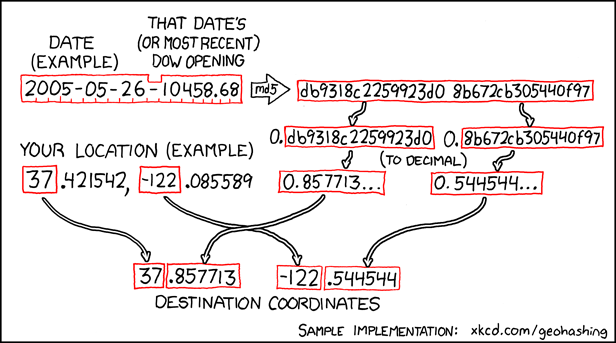
the algorithm by xckd for geohashing
The Algorithm as shown in xkcd comic #426
CC 2.0
The Algorithm captures the basics. I confess that I understood it very briefly, then not at all. But the wiki is extensive, and explains the rules quite clearly.

Randall Munroe is actually quite a talented illustrator. I scattered a selection of his geo-hashing illustrations throughout.

*All of Mr. Munroe's work is  reproduced here under terms of Creative Commons License 2.0, see icon above.

02 August 2010

Microsoft Tag at the Crossroads of Virtual and Physical Worlds

Will Microsoft clear the field as it enters the location-based service market? Microsoft provides this definition of Tag, whose scope is larger than I realized:
"A Tag is a high-capacity color bar code... Organizations and individuals can create specific Tags by using the Microsoft Tag Manager Web service. When the Microsoft Tag Reader application is installed on a mobile device, [it] can be used to scan a Tag using the built-in device camera. When a Tag is scanned by the Tag Reader, the information encoded into the Tag becomes available on the mobile device."
floatingsheep logo
Cyber sheep?
A tag is similar to a QR code. A tag must be
  • created and placed so that users can locate it in the physical world, NOT the virtual world of the interwebs AND 
  • rendered with adequate size and detail so it may be scanned accurately by mobile device cameras.
The purpose of this was not obvious to me. I had to approach it in steps.

Tag taxonomy


Let's start by defining a tag as a descriptive word or phrase associated with a noun, verb or idiom. I think of these as basic "virtual tags". Examples would be the word or word expression description associated by customers with Amazon.com merchandise. Since my own cognitive processes are driven by analogy to basic concepts learned, well, in elementary or middle-school, I think of a tag as a super-synonym. Better yet, a tag is a synonym with a promising future.

This is a mini-taxonomy of virtual and real-world tags:
  • Virtual Tags describe people, animals, objects and actions, but are applied within the virtual world, usually the internet.
  • Virtual Geo-tags are specific to physical location, and usually correspond to geo-spatial coordinates (GIS). Examples are the inverted teardrop place markers used to indicate locations in Google Maps and Mapquest. This type of tag is a virtual construct, despite its reference to a physical location.
  • Microsoft Tags are physical objects. They are associated with specific geo-spatial data, i.e. geographical locations in the real world. Using the Microsoft tag reader and a mobile phone camera, these physical Microsoft Tags can then be converted to Virtual Geo-tags.
Comprehension increases after viewing the image gallery of Microsoft Tag examples created by current users, or the implementation guide for web and mobile phone users. The latter is available as a PDF download.

Microsoft is offering its Tag service free of charge. They make no promises about the future though.

Intersection


Microsoft Tag reminds me of Floating Sheep's visualization of the urban cyberscape, or maybe "cyberspace". Floatingsheep is focused on mapping and analyzing:
"a hybrid place: the online extension of the socially constructed human landscape in which the lines between material place and digital representations of place blur."
The internet is evolving at a brisk clip.

floating sheep cyberscape
Urban Cyberscape
The image above, which seemed fanciful a year ago, is growing into a reality with QR codes and now Microsoft Tag.

24 July 2010

CF-18 Crash Alberta International Airshow


Pilot ejects moments prior to crash, narrowly escaping certain death from the impact and fiery wreckage.

Canadian Forces pilot Capt. Brian Bews ejects as his CF-18 fighter jet plummets to the ground during a practice flight on Friday, July 23, 2010. He was preparing for the weekend airshow.

CF18 accident
Witnesses hear odd engine sounds


Jet about to crash
Pilot parachuting safe and clear of nosediving fighter jet


CF-18 Aircraft escape system works according to intended design


Plane crashes
Flaming crash in Lethbridge County, Alberta


All photo images by Ian Martens, Lethbridge Herald via Associate Press

18 May 2010

The Evolution of Privacy on Facebook

I thought that the face peering out from the hole in the wall looked like Mark Zuckerberg rather than Google. It has curly hair like Mark although he isn't purple ... yet. 

The critter that is supposed to be Facebook is definitely gross, and might be a better fit with Google. Google is everywhere; however, today's post is about Facebook's incursion into users' privacy.

Man looking at woman from a hole in her wall
Horror once users realize their exposure to
intrusive online services! Overstated slightly...

Are Facebook users adequately aware of the status of their private or personally identifying information? Probably not.

The Evolution of Privacy on Facebook is a recent analysis by IBM Research scientist Matt McKeon. (He did this as a personal project, not as part of work for his employer, IBM).

Matt's analysis was thorough and revealing. It is summarized by a series of charts depicting user growth and information sharing on Facebook, at multiple points in time: 2005, 2006, 2007, 2009 (Nov), 2009 (Dec), and last month, April 2010.


Static 2005
Earliest "snapshot" of Facebook user privacy 2005

Matt's article analyzes the 6 charts in chronological order. 

07 May 2010

Arizona Immigration Law

As you can see in the sidebar, my Annex is located in Arizona. I am part of the majority of the people of the State of Arizona in favor of our recently passed immigration law.

I am also a Jewish woman, and know the difference between the Nazi modus operandi of World War II versus the intent of Arizona Senate Bill 1070. Apparently, the current general manager of the Phoenix Suns, our local NBA basketball team, does not know the difference. Yesterday, he compared Arizona law to Nazi Germany. It bothered me, a lot.

Today, I was pleased to read this succinct description via a now-moribund website about our immigration law, AZ SB 1070:
...[SB 1070], according to constitutional lawyers, mimics federal immigration. All it does is give local authorities the same enforcement ability afforded to federal law enforcement.
Also,
Did you know that every non-citizen in the US has been required to carry 'proof of status' documents since Congress passed the Alien Registration Act in 1940?
And finally,
... an Arizona State University constitutional law professor who helped to draft this Arizona bill states that law enforcement officers "may not consider race, color or national origin" in making any stops* or determining any aliens' immigration status. That is in the bill...
Why has there been such a backlash in the national media? Perhaps it is because residents of other states do not have personal exposure to the impact of illegal immigration on their economy in a myriad of ways. Our current governor is Republican. There was support amongst non-Republicans too; approximately 70% were in favor of the bill.

AZ SB 1070 is merely a state-level mirror of already existing federal law, which is applicable in most instances, nationwide.

* Yes, I acknowledge that it would be difficult for police to avoid using appearance (as the basis for probable cause) in initiating an immigration document request.

06 May 2010

Microwave Cooking For One

SF Weekly did a follow-up to their review of Microwave Cooking for One. On April 5, 2010, SFoodie (San Francisco Restaurants and Dining) featured the cookbook cover as the Pic of the Day:
lady with food pic
"Let's make one thing clear: there's nothing wrong with eating alone. We do it all the time, not just out of necessity but because sometimes it's nice to enjoy a meal in solitude. As for microwave cooking, well, sometimes you're in a hurry...

But we wouldn't go so far as Marie T. Smith and cook what might be steak in a microwave. And while we're sure Marie is probably actually a very happy lady, we're going to have to blame the photographer for producing such a pained portrait. Is there someone standing off to the side with a gun, demanding that Marie hover over that microwave produced buffet of pastel-colored food?"

SFoodie's caption for this image seemed apt, "The Saddest Cookbook Ever: Microwaving For One".

It was even more poignant when Marie T. Smith's daughter, Theresa, responded half-way through the 47-count SFoodie reader comment thread, describing her mother at the time of the book's publication in 1984. Marie Smith knew how it could be living alone, and felt that a single, divorced or widowed person deserved to eat as well as someone with a family. She had noticed the increasing numbers of single-person households in the early 1980's, according to her daughter. Marie addressed these concerns by offering free cooking classes for women who were trying to acclimate to such changes. Marie held many cooking classes in her own home.

Marie T. Smith passed away in 1987. However, her daughter thanked the publishers of SFoodie, and the commenters too, for the publicity. Apparently the Microwave Cooking for One cookbook remains in print, with its own website, still generating revenue 24 years later! There is a nice assortment of Pyrex antique cookware on the site, and a lot more of interest.

There are some amazing YouTube.com videos of Marie demonstrating how to cook a sunny-side up egg, cheeseburgers and more, in a microwave oven. Theresa uploaded them. All are segments from a Lakeland, FL network-news affiliate. Most were on-air in 1986. Instead of embedding here, I recommend a visit to YouTube, to the microwave cooking channel, to watch Marie T. Smith cook.